Have you ever opened a text message or social media chat and suddenly received “ASL?” 🤔 If you’re new to internet slang, that tiny three-letter abbreviation might leave you confused. You may wonder whether the person is asking a serious question, making a joke, or referring to something completely different.
The ASL meaning in text has been around for decades, yet it continues to appear in modern conversations across messaging apps, online games, social media platforms, and chat rooms. Interestingly, its meaning can change depending on the context, the platform, and even the age of the people using it.
Understanding common texting abbreviations like ASL helps you communicate more confidently online. Instead of guessing what someone means, you’ll know exactly how to respond and avoid awkward misunderstandings.
In this guide, you’ll learn what ASL means in text, where it came from, how people use it today, real conversation examples, alternative meanings, common mistakes, and much more. By the end, you’ll be able to recognize ASL instantly and use it naturally in your own online conversations. 🚀
What Does ASL Mean in Text? 💬
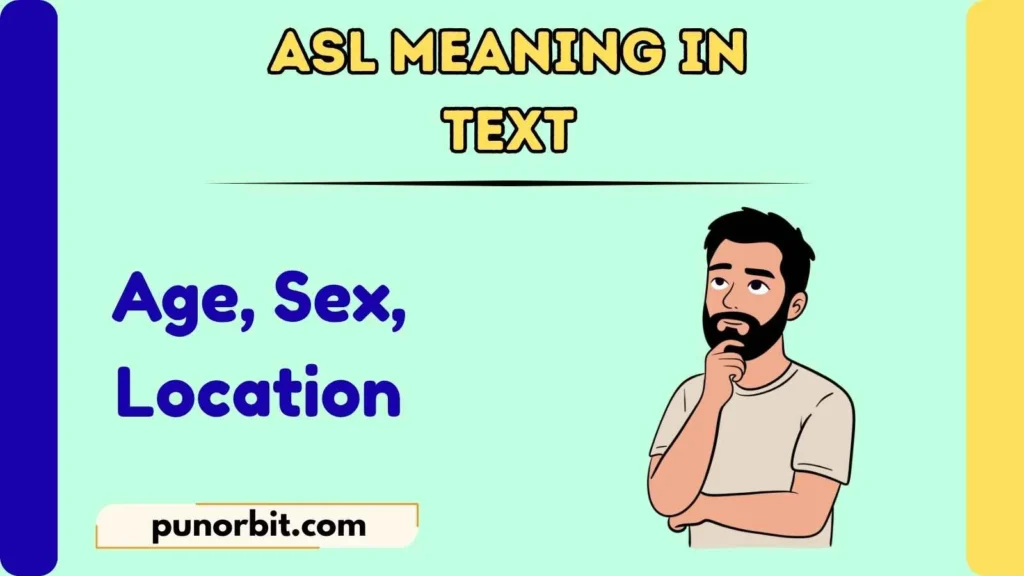
ASL most commonly stands for:
Age, Sex, Location
It is a short question people use when they want to learn basic information about someone they just met online.
Instead of typing:
- How old are you?
- Are you male or female?
- Where are you from?
People simply type:
“ASL?”
This abbreviation became extremely popular in online chat rooms because it saves time and allows conversations to move quickly.
Quick Definition
| Abbreviation | Meaning | Common Use |
|---|---|---|
| ASL | Age, Sex, Location | Introducing yourself in online chats |
Example
Person A: Hi!
Person B: ASL?
Person A: 21, Female, Texas.
In this example, the second person is simply asking for basic introductory information.
Today, however, ASL isn’t always used literally. Sometimes people say it jokingly, sarcastically, or even as a nostalgic reference to older internet culture.
The Origin of ASL in Online Conversations 🌍
The history of ASL meaning in text goes back to the early days of the internet.
Long before smartphones existed, people chatted on:
- Internet Relay Chat (IRC)
- AOL Instant Messenger
- MSN Messenger
- Yahoo Chat Rooms
- Online forums
- Gaming communities
Since typing every question repeatedly took time, internet users started shortening common phrases into abbreviations.
One of the most popular shortcuts became:
ASL = Age, Sex, Location
Back then, meeting strangers online was common, and people wanted a quick way to introduce themselves.
A typical conversation looked like this:
User 1: Hi.
User 2: ASL?
User 1: 18/F/California
Within seconds, both people had enough information to continue chatting.
Even though modern apps provide user profiles, ASL has survived as part of internet slang culture.
Today, younger users often recognize it through memes, nostalgic jokes, or conversations about early internet history.
Why Do People Still Use ASL Today? 🤳
You might think ASL disappeared years ago, but it still appears surprisingly often.
People continue using it for several reasons.
1. It’s Quick
Typing three letters is much faster than asking three separate questions.
Instead of writing:
“How old are you, what’s your gender, and where do you live?”
People simply write:
ASL?
2. It’s Part of Internet Culture
Many millennials grew up using chat rooms where ASL was extremely common.
Today, they sometimes use it as a nostalgic joke.
Example:
“Wow…this chat feels like 2005. ASL? 😂”
3. It Creates Conversation
ASL works as a simple icebreaker.
After exchanging introductions, people often continue discussing hobbies, interests, school, gaming, or work.
4. It’s Popular in Gaming
Gamers sometimes ask ASL when meeting new teammates.
Example:
Player 1: Nice game!
Player 2: Thanks! ASL?
Although not everyone answers, it’s still occasionally used in online gaming communities.
5. It Appears in Memes
Many social media memes reference old internet culture.
You’ll often see captions like:
“Only real internet veterans remember asking ASL first.”
These jokes introduce younger audiences to older texting slang.
How ASL Is Used in Different Platforms 📲
Although the meaning stays similar, the way people use ASL varies across different platforms.
Social Media
On social media, ASL usually appears:
- In direct messages
- Meme captions
- Comment sections
- Nostalgic posts
Example:
“Anyone remember when every chat started with ASL?”
Online Games
Gamers may ask ASL after several matches together.
Example:
Player: We’ve played together all week.
Friend: Haha true…ASL?
Dating Conversations
Some people still use ASL while getting to know someone online.
However, many dating apps already display this information, making ASL less necessary.
Group Chats
Friends sometimes use ASL humorously.
Example:
Friend 1:
Who’s joining the voice chat?
Friend 2:
ASL first 😂
Here, nobody expects a serious answer.
Community Forums
In discussion communities, ASL occasionally appears when users introduce themselves.
However, many forums now encourage safer and more private introductions.
Different Meanings of ASL in Text Depending on Context 🔍
Although Age, Sex, Location is the most common definition, ASL can mean several other things depending on where it’s used.
Understanding the context helps you interpret the abbreviation correctly.
1. Age, Sex, Location (Most Common)
This is the classic internet slang meaning.
Example:
ASL?
Meaning:
How old are you, what’s your gender, and where are you from?
2. American Sign Language 🤟
Outside texting slang, ASL often stands for American Sign Language.
Example:
I’m learning ASL.
Here, the person is talking about sign language—not internet slang.
3. Professional or Educational Context
Schools, colleges, and workplaces may use ASL as an abbreviation for different terms depending on the subject.
For example:
- Academic Support Learning
- Assessment Support Level
- Advanced Study Lab
These meanings are specific to organizations and are usually explained within the conversation.
4. Social Media Context
Sometimes people intentionally use ASL to confuse readers.
Example:
ASL?
Comments quickly fill with responses like:
American Sign Language?
Age Sex Location?
This playful ambiguity is common in meme culture.
Context Always Matters
Whenever you see ASL, ask yourself:
- Is this a casual chat?
- Is someone discussing sign language?
- Is this an educational topic?
- Is it a meme?
The surrounding conversation almost always reveals the intended meaning.
How to Reply When Someone Says “ASL?” 💬
If someone messages you with “ASL?”, don’t panic. The best response depends on your comfort level and the situation.
Here are some common ways to reply.
Option 1: Answer Directly
If you’re comfortable sharing basic details:
Them: ASL?
You: 22, Male, Chicago.
Simple and straightforward.
Option 2: Be General
You don’t have to reveal exact information.
Example:
You: Early twenties, USA.
This keeps some privacy while still answering.
Option 3: Ask Why
If you’re unsure about the person’s intentions:
You: Why do you ask?
This gives you more control over the conversation.
Option 4: Politely Decline
You’re never obligated to share personal details online.
Example:
You: I’d rather keep that private.
Most respectful people will understand.
Option 5: Joke Back 😂
Friends often use ASL playfully.
Example:
Friend:
ASL?
You:
Ancient • Alien • Mars 👽
Humorous replies are especially common among close friends.
Real-Life Examples of ASL in Text Conversations 💬
The easiest way to understand the ASL meaning in text is by seeing it in real conversations. These examples show how ASL can be used seriously, casually, or even as a joke depending on the situation.
Example 1: Meeting Someone Online
Alex: Hey! Nice to meet you.
Jordan: Nice to meet you too.
Alex: ASL?
Jordan: 20, Female, New York.
Here, ASL simply means Age, Sex, Location.
Example 2: Gaming Chat 🎮
Player 1: Great teamwork!
Player 2: Thanks! We’ve played together a few times now.
Player 1: Yeah! ASL?
Player 2: 24, Male, Canada.
The conversation becomes more personal after several games together.
Example 3: Group Chat Joke 😂
Friend 1: Who wants to join our movie night?
Friend 2: ASL first 😂
Friend 3: 95, Dinosaur, Jurassic Park.
Everyone understands it’s just a joke.
Example 4: Social Media Meme
Post:
Remember when every internet conversation started with ASL? 😅
Thousands of users immediately understand the nostalgic reference.
Example 5: American Sign Language Context 🤟
Emma: I’ve been learning ASL for six months.
Here, ASL clearly refers to American Sign Language, not internet slang.
Common Situations Where You Might See ASL 📱
Although ASL isn’t as common as it was years ago, you’ll still come across it in many online spaces.
Some of the most common places include:
- 💬 Text messages
- 📱 Snapchat chats
- 📸 Instagram DMs
- 🎵 TikTok comments
- 💙 Facebook Messenger
- 💻 Discord servers
- 🎮 Gaming chats
- 🌐 Online communities
- ❤️ Dating apps
- 😂 Meme pages
Every platform has its own communication style, but the abbreviation remains recognizable.
Is ASL Still Popular in 2026? 📈
Yes—but not in the same way it once was.
In the early 2000s, ASL was one of the most frequently used internet abbreviations. Almost every conversation in chat rooms began with it.
Today, things have changed.
Modern apps already display information like:
- Profile pictures
- Age
- Gender (if shared)
- Location
- Interests
- Bio
Because of this, there’s less need to ask Age, Sex, Location directly.
However, ASL continues to survive because of:
- Internet nostalgia
- Meme culture
- Gaming communities
- Casual online conversations
- Long-time internet users
Younger users often recognize ASL even if they’ve never personally used it.
When Should You Use ASL? ✅
Knowing the ASL meaning in text is helpful, but knowing when to use it is even more important.
Good Situations
✔ Friendly online communities
✔ Gaming conversations
✔ Casual chats
✔ Icebreakers among adults
✔ Nostalgic discussions
Situations to Avoid
❌ Professional conversations
❌ Workplace messaging
❌ School assignments
❌ Business emails
❌ Formal communication
Using ASL in formal settings may appear unprofessional or confusing.
Privacy Tips Before Answering ASL Questions 🔒
Although asking ASL is usually harmless, remember that you’re communicating with someone online.
It’s always smart to protect your privacy.
Helpful Safety Tips
- 🛡 Never share your full address.
- 🛡 Avoid giving personal phone numbers immediately.
- 🛡 Don’t reveal financial information.
- 🛡 Be cautious with strangers.
- 🛡 Trust your instincts if something feels suspicious.
- 🛡 Use platform privacy settings whenever possible.
If someone pressures you for personal information, it’s perfectly okay to stop responding.
Online safety should always come first.
“You never have to share personal information just because someone asks.”
That’s a good rule to remember whenever you’re chatting online.
Similar Texting Abbreviations You Should Know 📚
If you’re learning internet slang, ASL is just one of many popular abbreviations.
Here’s a handy comparison.
| Abbreviation | Meaning | Example |
|---|---|---|
| ASL | Age, Sex, Location | ASL? |
| BRB | Be Right Back | BRB, dinner time. |
| LOL | Laughing Out Loud | LOL, that’s funny! |
| IDK | I Don’t Know | IDK what happened. |
| IMO | In My Opinion | IMO, that’s the best option. |
| TBH | To Be Honest | TBH, I agree. |
| FYI | For Your Information | FYI, the meeting moved. |
| SMH | Shaking My Head | SMH, unbelievable. |
| NGL | Not Gonna Lie | NGL, I enjoyed it. |
| TTYL | Talk To You Later | Bye! TTYL. |
Learning these abbreviations makes texting much easier and helps you understand conversations across different platforms.
Common Misunderstandings About ASL ❌
Many people misunderstand ASL because it has more than one meaning.
Let’s clear up the biggest misconceptions.
Myth 1: ASL Always Means American Sign Language
Not necessarily.
If someone texts:
ASL?
They’re almost certainly asking about Age, Sex, Location.
If someone says:
I’m studying ASL.
They’re referring to American Sign Language.
Context is everything.
Myth 2: ASL Is Outdated
While it’s less common than before, it’s far from forgotten.
Millions of internet users still recognize it instantly.
Myth 3: Everyone Uses ASL
Not anymore.
Some people prefer asking individual questions instead of using abbreviations.
Others have never used ASL at all.
Myth 4: You Must Answer
Absolutely not.
Sharing personal information online is always your choice.
You can answer partially—or not at all.
ASL Meaning Across Different Generations 👥
One interesting thing about ASL is how different age groups understand it.
Millennials
Many millennials remember using ASL every day in chat rooms.
For them, it’s a nostalgic piece of internet history.
Generation Z
Gen Z usually recognizes ASL from:
- Memes
- TikTok videos
- Reddit discussions
- Gaming communities
Some use it ironically rather than seriously.
Generation Alpha
Younger users may know ASL primarily as American Sign Language before learning its older internet slang meaning.
This is why context matters more than ever.
Why Context Changes the Meaning of ASL 🎯
The same three letters can represent completely different ideas.
Consider these examples:
Example 1
ASL?
Meaning:
Age, Sex, Location
Example 2
She teaches ASL.
Meaning:
American Sign Language
Example 3
Again, this refers to American Sign Language.
Example 4
Remember AOL chat rooms? ASL? 😂
This is clearly referencing the classic internet abbreviation.
Whenever you’re unsure, simply read the surrounding conversation.
The context almost always provides the correct answer.
ASL in Pop Culture and Internet Humor 🎭
Even though modern messaging apps have changed the way people communicate, ASL continues to appear in internet humor.
You’ll often find jokes like:
“Kids today will never understand starting every chat with ASL.
Or:
“The internet in 2003:
Hi.
ASL?”
These memes celebrate the early days of online communication and remind long-time internet users of simpler chat experiences.
Because of this nostalgic value, ASL has become more than just an abbreviation—it has become part of internet history.
ASL vs Other Common Texting Abbreviations 📊
If you’re new to internet slang, it helps to compare ASL with other abbreviations that appear frequently in text messages and social media. While many abbreviations express emotions or reactions, ASL is mainly used to ask for introductory information.
| Abbreviation | Full Form | Primary Purpose |
|---|---|---|
| ASL | Age, Sex, Location | Ask basic personal information |
| LOL | Laughing Out Loud | Express laughter |
| BRB | Be Right Back | Indicate a short break |
| TBH | To Be Honest | Share an honest opinion |
| NGL | Not Gonna Lie | Introduce a truthful statement |
| SMH | Shaking My Head | Show disappointment or disbelief |
| IDK | I Don’t Know | Express uncertainty |
| TTYL | Talk To You Later | End a conversation politely |
| IMO | In My Opinion | Share a personal viewpoint |
| IRL | In Real Life | Refer to offline life |
Learning these abbreviations can make online conversations easier to follow and help you communicate naturally across different platforms.
Mistakes People Make When Using ASL ⚠️
Although ASL meaning in text is straightforward, people sometimes misuse it. Avoiding these common mistakes will help you communicate more clearly.
Assuming Everyone Knows ASL
Not everyone is familiar with older internet slang. Some people may immediately think of American Sign Language instead of Age, Sex, Location.
Using ASL in Formal Conversations
ASL belongs in casual chats, not professional emails, workplace discussions, or academic writing.
Asking Personal Questions Too Soon
Sending “ASL?” immediately after greeting someone can feel intrusive. Building a little conversation first is often more comfortable.
Ignoring Privacy
Remember that not everyone wants to share their age, gender, or location. Respect other people’s boundaries if they choose not to answer.
Misreading the Context
Always consider the surrounding conversation. If someone is discussing accessibility, education, or the Deaf community, ASL almost certainly refers to American Sign Language.
Quick Tips for Using ASL Naturally 💡
If you decide to use ASL in online conversations, these tips can help.
- 😊 Use it only in casual conversations.
- 😊 Respect privacy if someone doesn’t answer.
- 😊 Read the context before assuming the meaning.
- 😊 Don’t use ASL in professional communication.
- 😊 Recognize that many younger users may interpret it differently.
- 😊 Remember that user profiles often provide this information already.
Using internet slang appropriately helps conversations feel more natural and respectful.
ASL meaning in text usually stands for Age, Sex, Location. It is a common internet abbreviation used to ask someone their age, gender, and where they are from. Depending on the conversation, ASL can also mean American Sign Language, so understanding the context is essential.
FAQs
What does ASL mean in text?
The most common ASL meaning in text is Age, Sex, Location. It’s a short way of asking someone for basic introductory information during an online conversation.
Does ASL always mean Age, Sex, Location?
No. While Age, Sex, Location is the classic internet slang meaning, ASL can also stand for American Sign Language or other specialized terms in educational or professional settings. The surrounding conversation determines the intended meaning.
Is ASL still used today?
Yes. Although it isn’t as common as it was during the early internet era, ASL still appears in gaming communities, social media, nostalgic discussions, and casual online chats.
Is it safe to answer ASL questions?
It depends on who is asking. If you’re chatting with someone you trust, you may choose to answer. However, when talking to strangers online, it’s best to protect your privacy and avoid sharing more information than you’re comfortable with.
Should I use ASL in professional messages?
No. ASL is considered informal internet slang and isn’t appropriate for business emails, workplace communication, or academic writing. Use complete sentences in professional settings.
Final Thoughts 📝
Understanding the ASL meaning in text helps you navigate online conversations with confidence. While the abbreviation traditionally stands for Age, Sex, Location, its meaning isn’t always the same. In many conversations, especially those involving accessibility or education, ASL refers to American Sign Language instead.
The key is paying attention to the context. Whether you’re chatting with friends, joining an online gaming session, scrolling through social media, or reading comments, recognizing the intended meaning prevents confusion and helps you respond appropriately.
Although internet slang continues to evolve, ASL remains one of the most recognizable abbreviations from the early days of online communication. Knowing when to use it—and when not to—makes you a more informed and respectful digital communicator.

Peter Hemsworth is the mind behind PunOrbit.com, where internet slang, viral phrases, and everyday words reveal their hidden meanings. He transforms simple expressions into captivating stories that expose what people truly mean beneath the surface. Step into PunOrbit.com and discover a universe where every word hides a deeper secret waiting to be uncovered.